
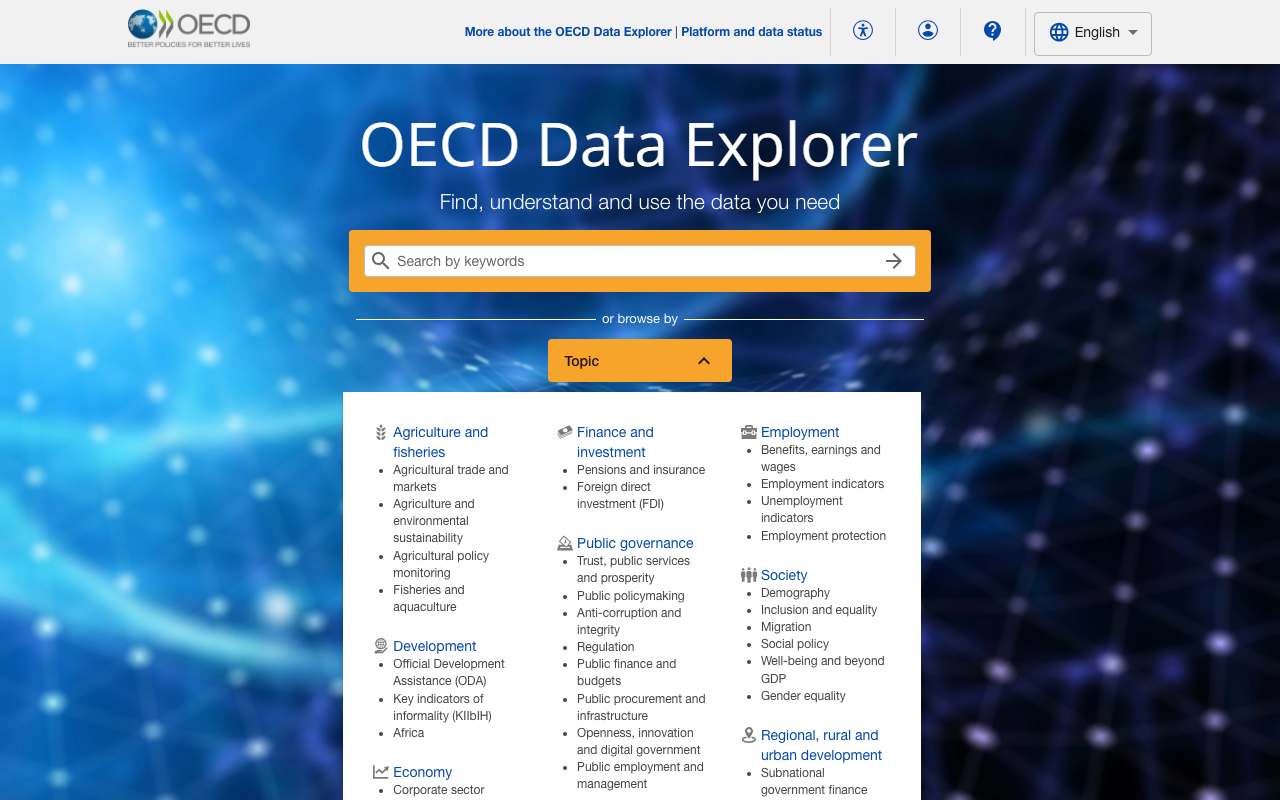
OECD Data Explorer
Over 1,500 OECD tables on work, income, taxes, education, health, housing and the environment. Measured the same way for every member country, so good for comparing the Netherlands with countries outside Europe, such as the United States, Japan or Canada.
This page was built from the catalogue and the daily status check. A full page also gets charts from the source itself, its pitfalls, sample code and sites that use it.
Everything that's in it1,550
All dataflows in the OECD Data Explorer, in the OECD's own topic structure, fetched every night. A dataflow can sit under several topics. Every dataflow has its own page with the SDMX call for the latest Dutch observation, the number of observations and the period.
What you can build with it1
What can you do with it?4 ideas
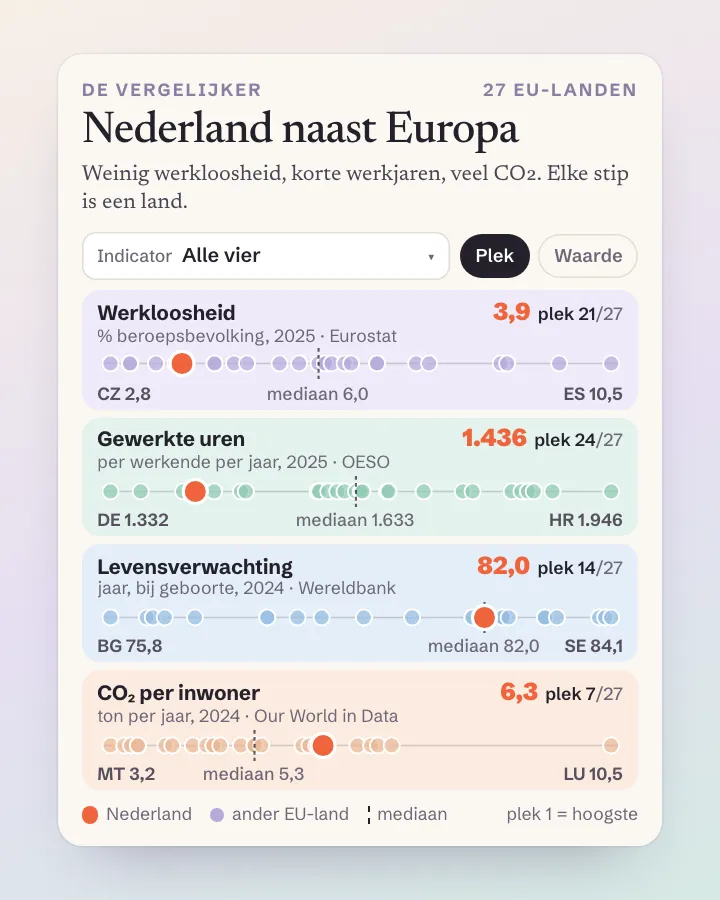
Do we really work so little?
A worker in the Netherlands worked an average of 1,436 hours in 2025, against 1,332 in Germany, 1,586 in Belgium and 1,800 in the United States (OECD, actual hours worked per worker per year). In 1970 it was still 1,809 hours in the Netherlands.
Monthly unemployment next to the neighbours
In August 2026 unemployment in the Netherlands was 4.0 percent, the same as Germany. Belgium was at 5.9 and the OECD average at 5.0 percent (seasonally adjusted, aged 15 and over).
Tax burden on wages
The OECD calculates for each country how much tax and social contributions an employee and employer pay. Compare the Netherlands with countries outside the EU, which Eurostat does not cover.
One URL per chart
Build a fixed API call with lastNObservations and let a chart update itself as soon as the OECD publishes a new month.
How to process it4 steps
Find the table in the Data Explorer
Pick a table, set the filters and open 'Developer API'. It shows the SDMX call that fetches exactly your selection.
Or search the list of all tables
One call returns all 1,550 tables (dataflows) with id, version and issuing directorate (15 Oct 2026, 10 MB).
https://sdmx.oecd.org/public/rest/dataflow/all
Read which dimensions exist
The key in the URL has one position per dimension, separated by dots. Empty = everything. Request the structure with references=all to see the order and the codes.
https://sdmx.oecd.org/public/rest/dataflow/OECD.ELS.SAE/DSD_HW@DF_AVG_ANN_HRS_WKD/1.0?references=all
Fetch data as CSV
With format=csvfilewithlabels you get codes and names. Separate several countries with a plus: NLD+DEU+BEL.
https://sdmx.oecd.org/public/rest/data/OECD.SDD.TPS,DSD_LFS@DF_IALFS_UNE_M,1.0/NLD+DEU+BEL+OECD.UNE_LF_M.PT_LF_SUB._Z.Y._T.Y_GE15._Z.M?lastNObservations=1&dimensionAtObservation=AllDimensions&format=csvfilewithlabels
Interesting combinations

Similar sources
 Eurostat
Europe only, but much more regional detail (NUTS).
 World Bank indicators
All countries in the world, less depth per topic.
 Our World in Data
Curated series with explanations and charts, partly based on OECD figures.
What to watch out for
- Wrong code = 404, not an empty list
A key without results returns HTTP 404 with the text NoResultsFound. The default view in the metadata even named code UNE_M for monthly unemployment, while the data use code UNE_LF_M (15 Oct 2026). Start with just the country, then fill in the other dimensions.
- Choose every dimension deliberately
If you leave a dimension empty you get all variants mixed: for hours worked, e.g., all workers (_T) and employees only (ICSE93_1). For the Netherlands these differ by more than 80 hours a year (2025).
- Rows come unsorted
The CSV is not sorted by country or year. Sort it yourself before plotting a series.
- Website refuses scripts
On 15 October 2026 www.oecd.org (including the API guide and the terms) returned HTTP 403 to our honest user agent. The API on sdmx.oecd.org did work. The manual is available as a PDF on gitlab.algobank.oecd.org.
APISDMX 2.1 REST (ook SDMX REST 2.0) · read 16 Oct 2026
No key or account needed tested
dataflows (tables) in dataflow/all (16 Oct 2026) tested
csvjsonxml
Base URL
https://sdmx.oecd.org/public/rest
Endpoints 6
- GET
/data/{agency},{dataflow},{versie}/{sleutel}Data (SDMX API 1). Key: one position per dimension (without time), dots between, + for several codes, empty = all. Example: OECD.SDD.TPS,DSD_LFS@DF_IALFS_UNE_M,1.0/NLD+DEU.UNE_LF_M.PT_LF_SUB._Z.Y._T.Y_GE15._Z.M - GET
/v2/data/dataflow/{agency}/{dataflow}/{versie}/{sleutel}Data (SDMX API 2): one code per dimension, * as wildcard, time with c[TIME_PERIOD]=ge:2018+le:2024. Version + = latest. - GET
/dataflow/allAll 1,550 dataflows with id, agency, version and name (10 MB as JSON with Accept application/vnd.sdmx.structure+json). - GET
/dataflow/{agency}/{dataflow}/{versie}?references=allOne dataflow with data structure, code lists and concepts: the order of the dimensions and all codes. - GET
/availableconstraint/{agency},{dataflow},{versie}/{sleutel}/all/{dimensie}Which codes of one dimension have data for this key, plus the number of observations (obs_count). Handy to find the right MEASURE code. - GET
/codelist/{agency}/{codelijst}Code list with names, e.g. /codelist/OECD/CL_AREA (countries and areas, 576 kB JSON).
Filtering tested
Series key in the path: codes in dimension order, dots between, + for several codes, empty for all. Time with startPeriod/endPeriod or lastNObservations.
Parameters 10
startPeriod | Start (inclusive): 2015, 2015-Q1, 2015-01 or 2015-M01, 2015-01-01. | tested |
endPeriod | End (inclusive), same notation. | tested |
lastNObservations | At most N observations per series, from the latest. lastNObservations=1 = latest month only. | tested |
dimensionAtObservation | AllDimensions = flat list (handy for JSON); default grouped per time series. | from the description |
format | csvfile (CSV file), csvfilewithlabels (codes and names), csv, jsondata, genericdata, structurespecificdata. Without format: SDMX-ML generic. | tested |
detail | Full (default), DataOnly, SeriesKeysOnly, NoData. | tested |
updatedAfter | Only observations added, changed or deleted since this moment (with time zone, e.g. 2026-10-01T00:00:00+02:00). | from the description |
firstNObservations | At most N observations per series, from the oldest. | tested |
includeHistory, asOf | Listed among the allowed parameters the API returns for an unknown parameter; not tested further. | tested |
references | For structure queries: all (everything that belongs to it), with detail=referencepartial. | from the description |
Columns in format=csvfile (monthly unemployment) 9
| Name | Type | Meaning |
|---|---|---|
DATAFLOW | tekst | Agency, dataflow en versie, bv. OECD.SDD.TPS:DSD_LFS@DF_IALFS_UNE_M(1.0) |
REF_AREA | code | Land (ISO3: NLD, DEU, BEL) of groep (OECD, EA20) |
MEASURE | code | Wat er gemeten is, bv. UNE_LF_M (werkloosheid per maand) |
UNIT_MEASURE | code | Eenheid, bv. PT_LF_SUB (procent van de beroepsbevolking in dezelfde groep) |
ADJUSTMENT | code | Y = seizoens- en kalendergecorrigeerd |
TIME_PERIOD | periode | Periode: 2025, 2026-08, 2026-Q2 |
OBS_VALUE | getal | De waarde |
OBS_STATUS | code | Status van de waarneming (A = normaal) |
UNIT_MULT | getal | Macht van tien waarmee de waarde vermenigvuldigd is (0 = geen) |
Limits and pitfalls
- Calls in quick succession get a 429. Back off (15, 30, 45 s) and rather ask for several countries at once with +. experience
- The OECD announced a limit on data downloads in November 2024 (page 'API best practices'; search results mention 60 per hour). That page on www.oecd.org returned 403 to us, so we did not read the number ourselves. experience
- No key needed. Send Accept-Encoding: gzip; dataflow/all is 10 MB. tested
- No result = HTTP 404 with the plain text NoResultsFound, not an empty list. tested
- An unknown parameter (e.g. lang=en) returns 403 with the list of allowed parameters: startPeriod, endPeriod, updatedAfter, firstNObservations, lastNObservations, dimensionAtObservation, detail, includeHistory, asOf (format also works). tested
- Wrong number of dimensions in the key: availableconstraint returns 403 'Not enough key values in query, expecting 9 got 11'; data just returned NoResultsFound. Count the dots. tested
- Codes in the default view do not always match the data: the metadata named UNE_M, the data use UNE_LF_M. Ask availableconstraint for the MEASURE dimension. tested
- Accept-Language: * (the Node fetch default) returns HTTP 500 'Internal server error', on structure and data queries (measured with curl: without that header 200, with it 500; a response already in the OECD cache does get through). Set Accept-Language: en yourself. According to the manual the SDMX-CSV separator also depends on Accept-Language (sometimes ;). tested
- If you leave a dimension empty you get all variants mixed (for hours worked: all workers and employees only). Choose every dimension deliberately. experience
- CSV rows are not sorted by country or period. csvfilewithlabels has a different header (STRUCTURE, STRUCTURE_ID, with a name column next to every code). tested
- Dataflows sometimes point to an older structure version; without a version in the path (SDMX API 1) or with + (API 2) you get the latest, which is not always backwards compatible. from the description
- The Data Explorer has a 'Developer API' button per table with exactly the call for your selection. from the description
Try it HTTP 200 · 1,242 ms · 16 Oct
https://sdmx.oecd.org/public/rest/data/OECD.SDD.TPS,DSD_LFS@DF_IALFS_UNE_M,1.0/NLD+DEU+BEL.UNE_LF_M.PT_LF_SUB._Z.Y._T.Y_GE15._Z.M?lastNObservations=2&format=csvfile
DATAFLOW,REF_AREA,MEASURE,UNIT_MEASURE,TRANSFORMATION,ADJUSTMENT,SEX,AGE,ACTIVITY,FREQ,TIME_PERIOD,OBS_VALUE,BASE_PER,OBS_STATUS,UNIT_MULT,DECIMALS
OECD.SDD.TPS:DSD_LFS@DF_IALFS_UNE_M(1.0),BEL,UNE_LF_M,PT_LF_SUB,_Z,Y,_T,Y_GE15,_Z,M,2026-08,5.9,,A,0,1
OECD.SDD.TPS:DSD_LFS@DF_IALFS_UNE_M(1.0),BEL,UNE_LF_M,PT_LF_SUB,_Z,Y,_T,Y_GE15,_Z,M,2026-07,6,,A,0,1
OECD.SDD.TPS:DSD_LFS@DF_IALFS_UNE_M(1.0),DEU,UNE_LF_M,PT_LF_SUB,_Z,Y,_T,Y_GE15,_Z,M,2026-08,4,,A,0,1
OECD.SDD.TPS:DSD_LFS@DF_IALFS_UNE_M(1.0),DEU,UNE_LF_M,PT_LF_SUB,_Z,Y,_T,Y_GE15,_Z,M,2026-07,4,,A,0,1
OECD.SDD.TPS:DSD_LFS@DF_IALFS_UNE_M(1.0),NLD,UNE_LF_M,PT_LF_SUB,_Z,Y,_T,Y_GE15,_Z,M,2026-08,4,,A,0,1
OECD.SDD.TPS:DSD_LFS@DF_IALFS_UNE_M(1.0),NLD,UNE_LF_M,PT_LF_SUB,_Z,Y,_T,Y_GE15,_Z,M,2026-07,4,,A,0,1
Shortened response, saved at harvest time. Click the URL for the real, current response.
Read from OECD Data API documentation (PDF, updated 17 Sep 2026): data and structure queries, parameters, formats · List of all dataflows (SDMX structure). Labels: from the description stated in what the api itself publishes. tested from our own small call. platform applies to every api on this platform, per its documentation. experience learned while building open data index.
How to fetch it
curl "https://sdmx.oecd.org/public/rest/data/OECD.ELS.SAE,DSD_HW@DF_AVG_ANN_HRS_WKD,1.0/NLD+DEU+BEL+USA........_T....?startPeriod=2025&format=csvfilewithlabels"
More from OESO in our index
1,550 datasets in OECD Data Explorer. These changed most recently.
- Quarterly employment by institutional sector, domestic concept2026-10-16
- Quarterly Sector Accounts (for 'Developer API')2026-10-16
- Quarterly non-financial accounts by institutional sector (Revenue)2026-10-16
- Quarterly non-financial accounts by institutional sector (Expenditure)2026-10-16
- Distribution of students in vocational education and training programmes by level of education2026-10-15
- Enrolment rate by age2026-10-15
More in this topic



See how this page is built
bron: oecd-data
blokken: []
secties:
  - ideeen
  - verwerken
  - koppelingen
  - vergelijkbaar
  - beperkingen
  - code
cache:
  tag: bron:oecd-data
  ververs: na statuscheck, als de bron nieuwer is
statuscheck:
  methode: nieuwste maand van de werkloosheid in Nederland (SDMX-API)
  verwacht: maandelijks
Source: content/bronnen/oecd-data.yaml · Markdown